

This series is about the forces reshaping polymer choices in beauty formulations. We covered why everyone uses synthetic polymers in Part 1, regulatory pressure forcing change in Part 2, and shifting consumer perceptions in Part 3.
That leaves us with Part 4: what are the options? In today’s post, we map the natural polymer landscape to find out what’s available, what works, what doesn’t, and what the ideal solution would look like.
What We Need From a Carbomer Replacement
Before evaluating alternatives, it’s worth setting out what a true carbomer replacement would need to deliver.
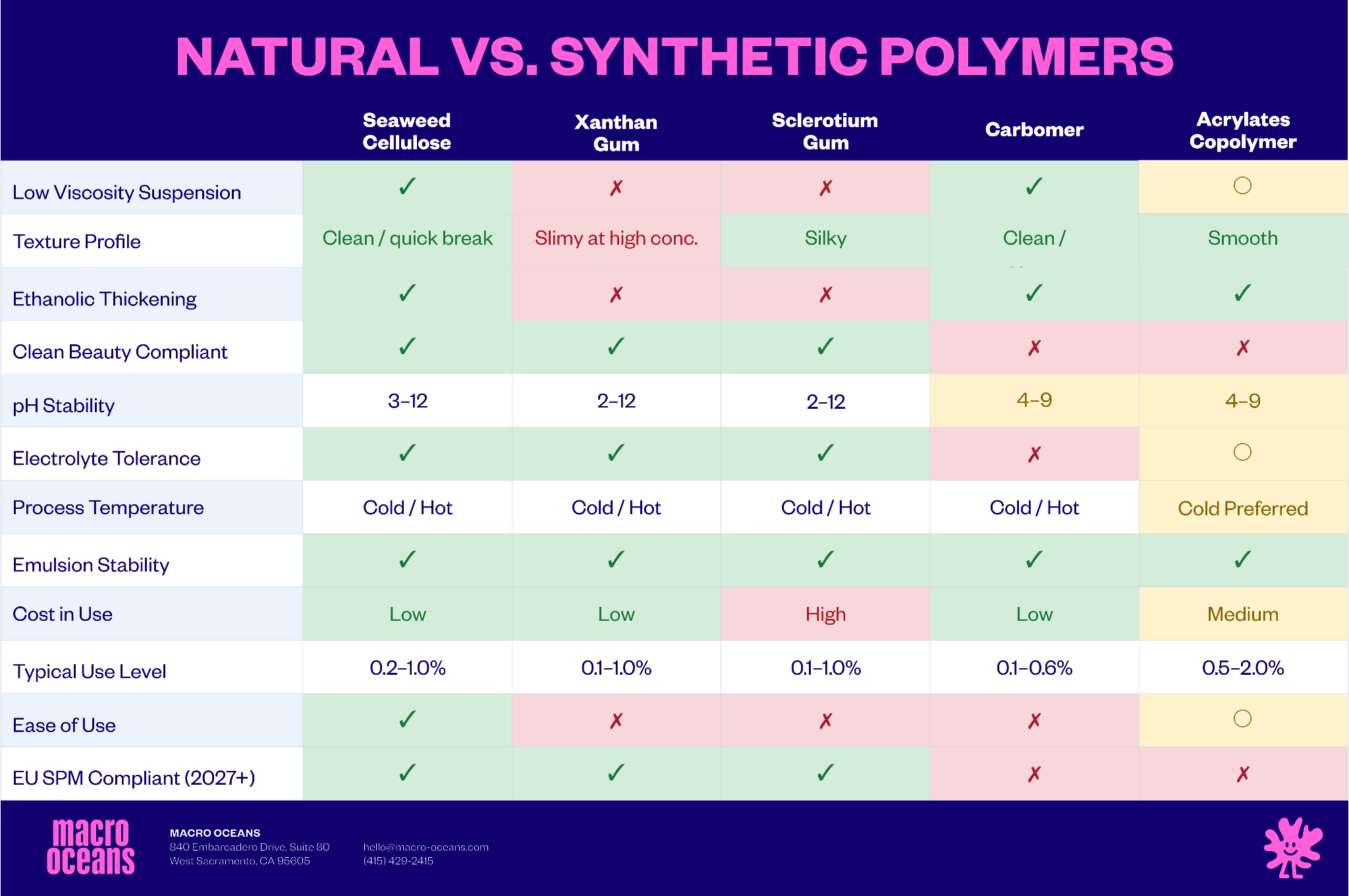
Performance: carbomers have three critical performance characteristics: (i) extremely high water absorbency - 1000x its weight in water, (ii) excellent shear thinning at low shear rates, without a plateau, (iii) ability to suspend heavy particles like mineral sunscreen actives. A perfect replacement should have these properties and also be pH stable from 3-12, electrolyte tolerant, and thermally stable.
Compliance: any carbomer replacement needs to fall outside of EU “synthetic polymer microparticle” classification, either because it’s a natural polymer or because it’s proven biodegradable. And it should be compatible with established no-no lists at major retailers.
Easy-to-Use: finally, the ideal replacement would have comparable cost-in-use, similar processing requirements (i.e. no specialized equipment or processes), and a sustainable and traceable supply chain.
That’s a demanding list and explains why many natural alternatives ask the formulator to compromise on artistry.
The Current Natural Options
Let’s walk through the most frequently used natural alternatives to review strengths and limitations.
Xanthan Gum is the default choice for “natural” formulations seeking rheology modification.
Strengths: Clean-label compatible, widely available, low cost, good emulsion stability, pH stable across 2-12 range
Limitations: gets slimy at higher concentrations and requires high shear stress to break viscosity, leaving a tacky feeling on the skin. Can’t suspend heavy particles without significant viscosity. Requires predispersion in a glycerin / glycol to improve yields but also creates more complexity, cost and waste during manufacturing.
Our verdict: Adequate for simple thickening applications but fails to deliver carbomer-like performance in suspensions and textures.
Sclerotium Gum is a fermentation-derived polysaccharide sometimes positioned as a premium natural alternative.
Strengths: silky texture profile, clean-label compatible, good emulsion stability.
Limitations: No suspension capabilities in low-viscosity systems. High cost-in-use compared to xanthan gum and can be difficult to work with in formulation.
Our verdict: Better texture than xanthan, but the premium price is hard to justify given the performance limitations.
Guar Gum is a galactomannan polysaccharide extracted from guar beans.
Strengths: Natural, low cost, widely available.
Limitations: Low water absorbency (10-15x its weight in water) which translates to poor shear thinning and no meaningful suspension capability.
Our verdict: Generally inferior to xanthan gum and not a serious candidate for replacing carbomer.
Traditional Cellulose Derivatives include hydroxyethyl cellulose, hydroxypropyl cellulose, and other such wood-derived cellulose materials.
Strengths: naturally-derived with established supply chains and familiar to formulators.
Limitations: Wood-derived cellulose has short fibers that limit water absorbency leading to poor shear thinning, hard-to-dispense formulas, and limited suspensions.
Our verdict: incremental improvement over gums in some applications, but not carbomer-equivalent.
Modified Natural Polymers are chemically modified starches and celluloses like carboxymethyl cellulose designed to improve performance
Strengths: performance can approach synthetics in some applications
Limitations: “modification” may fall foul of EU regulations depending on the degradation / solubility testing, not considered clean in the minds of consumers
Our verdict: these polymers fall into a gray zone that neither delivers performance nor regulatory / clean label compliance
Seaweed Polymers: The New Kid On The Block
Cellulose is the skeleton of plant life. These long chains of glucose structures are one of the most abundant organic molecules on earth. They bundle together into fibers, whose shape and length, and thus performance, depends entirely on what the plant needs to do.
Land plants have evolved to resist gravity. Trees grow upwards, holding up branches and leaves. So their cellulose fibers are relatively short and thick, packed tightly into building blocks to create rigidity.
Seaweed evolved to resist tides and wave action (there’s no gravity to fight underwater!). Their fibers are long, thin and flexible, creating incredible tensile strength. Seaweed can be many feet long but just sway in the current without snapping.
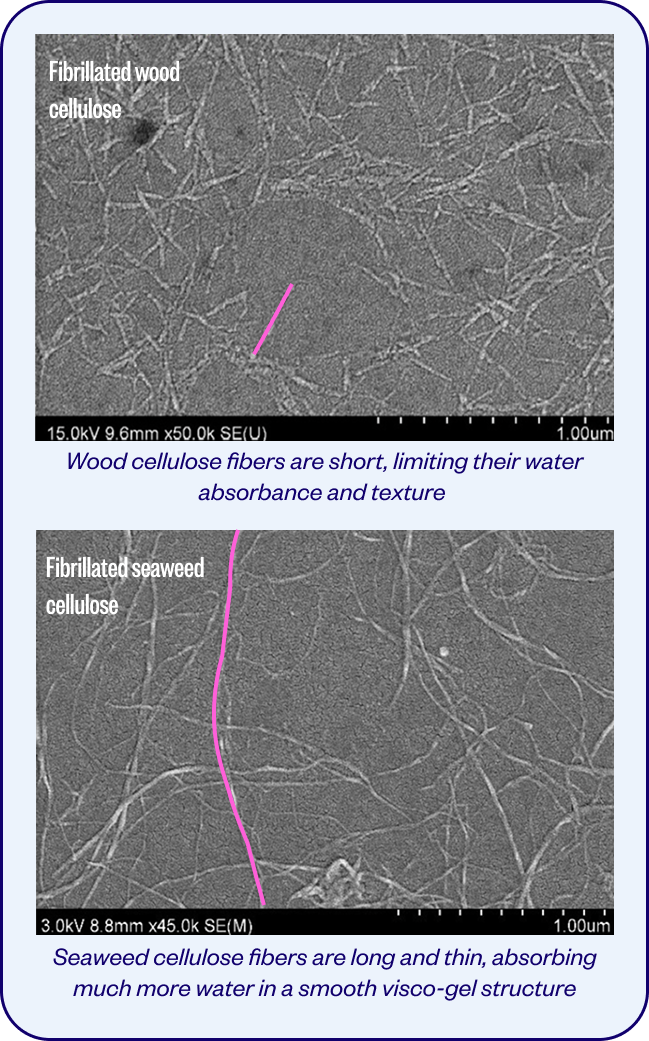
At the molecular level, this manifests in the fiber’s aspect ratio (length vs. width). Wood-based cellulose fibers are short with low aspect ratios, while seaweed fibers are hundreds of times longer with high aspect ratios (see the electron microscope images below).
Unique Structure = Unique Function
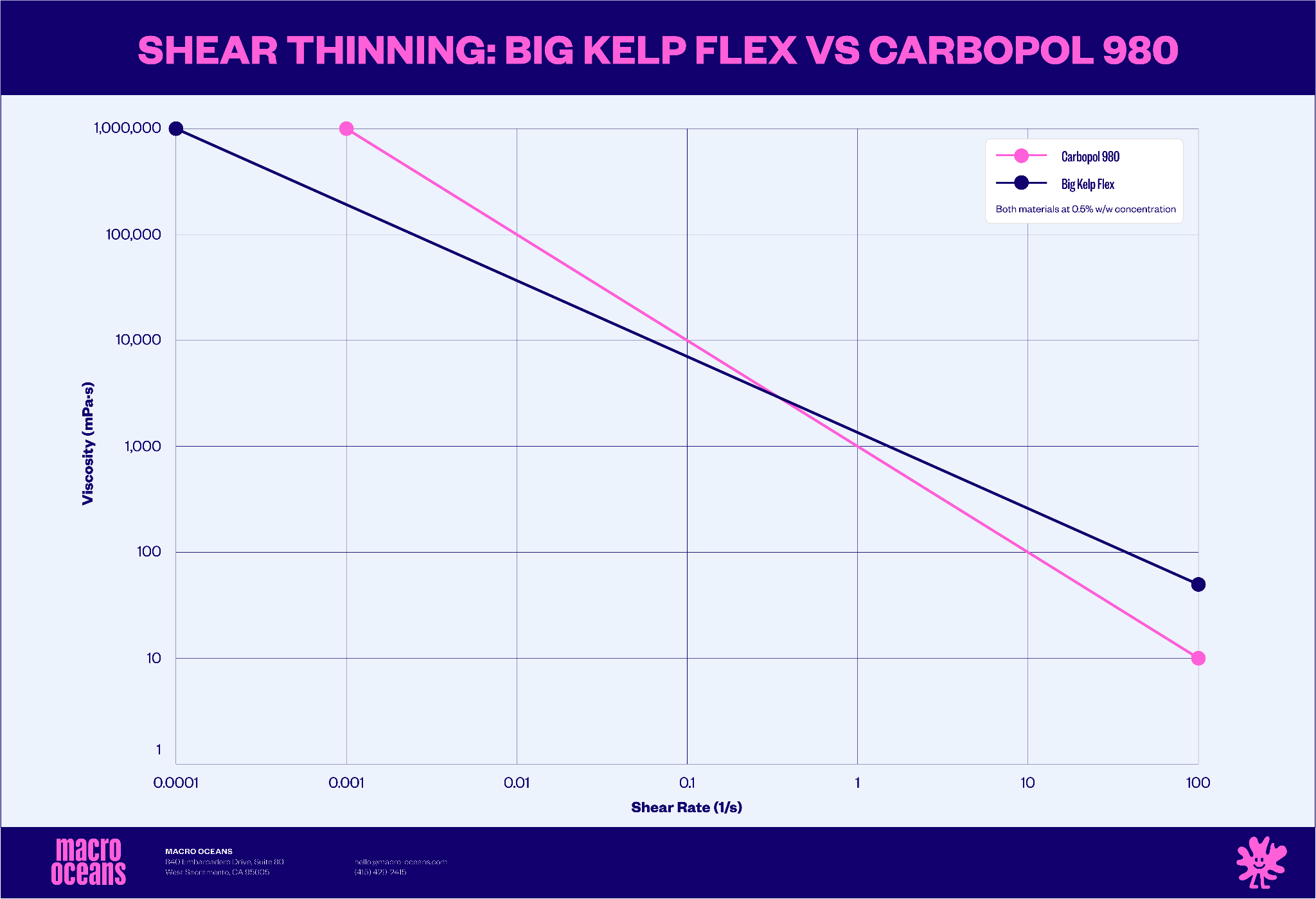
This structural difference turns out to matter a lot in how the ingredient performs in formulations. Seaweed cellulose can absorb up to 600x its weight in water, putting it into the superabsorbent polymer range. These long fibers create smooth visco-gel structures allowing for shear thinning and shear stress properties that mirror carbomer behavior.
This makes seaweed cellulose perfect for:
Suspension of heavy particles: you can suspend mineral sunscreen actives in formulations and rest assured it will spray. This was essentially impossible with traditional natural polymers.
Beautiful textures: seaweed cellulose has a shear thinning/stress profile on par with carbomer. The viscosity drops immediately when rubbed into the skin, leaving no residue (aka “soaping”). Formulators can create unparalleled sensory experiences with natural polymers.
Formulation flexibility: the material works across the pH range (3-12), tolerates electrolytes, processes at cold or hot temperatures. It’s easy to work with, meaning both bench chemists and production teams will be happy.
The science behind this new class of materials has advanced rapidly over the past decade, and improvements in modern biotechnology have made commercial-scale production of high-purity seaweed cellulose at competitive prices possible.
So what will you create?
Beauty, like all industries, doesn’t stand still. Amid the seemingly endless flow of new products, here are brands and launches that define an era. These (rare) category creators are the ones that see a convergence before everyone else does. They match shifting consumer expectations to maturing technology, and something that seemed implausible last year, suddenly becomes inevitable.
When Apple launched the iPhone, they didn’t set out to build a better phone. They realized that advances in touchscreens, mobile processors, and wireless networks had all matured at the same time. So now they could put a computer in your pocket. They gave consumers something that consumers didn’t even know was possible.
Likewise, when the clean beauty movement started, these pioneers understood the scientific evidence but also realized that the technological solutions already existed. They redefined what consumers could expect from their products. The brands that set those standards created category leadership.
But no industry stands still. In beauty, the next frontier isn’t just “free from bad stuff.” It’s about expanding what you can create. Natural polymers have now crossed the performance threshold meaning that the trade-off that defined the last decade of clean formulation is ending.
The material shift underway is bigger than one regulation and bigger than one product category and bigger than just the beauty industry. When the underlying materials change, it creates an opportunity to rethink everything that is built on top of them. The world is at the beginning of a platform shift away from synthetic polymers, in beauty, but also beyond.
The window to create is open. Are you going to write a new playbook? Or read someone else’s?
Sophisticated, creative and probably cost effective .