

Welcome to Part 3 of our series on the beauty industry’s transition from synthetic to natural high performance polymers. This week we’re taking a look at consumer perceptions of synthetic and natural polymers, diving into what the scientific literature tells us, and reviewing what retailers are doing.
And in case you missed the other posts in our series, here is Part 1 (our love letter to carbomers) and Part 2 (our deep dive into EU regulations on microplastics).
US Consumers: Microplastics are a Health Concern
For consumers, microplastics started out primarily as an environmental concern. We were bombarded with images of the Great Pacific Garbage Patch, sea turtles swimming with trash, and distant beaches littered with plastic debris. But more recently, microplastics have become personal.
Scientists have published studies proving that microplastics are commonly found in human blood and can bioaccumulate in our organs (more on the latest scientific evidence below). The media conversation has rapidly shifted to the impact on our health. Everyone now wonders: what’s already in my body and how can I avoid yet more microplastics?
For brand leaders, paying attention to this shifting landscape is important because where the consumer goes, the regulators often follow. For example:
Mid 2010s: The Microbead Era. Consumers revolt against the visible plastic beads in their exfoliating scrubs. Campaigns like Beat the Microbead had a simple solution: ban the beads.
2015-2023: Regulators Respond. The Microbead-Free Waters Act was passed by Congress in 2015 and the EU followed soon thereafter, removing these products from the shelves.
In 2025, a Grove/5 Gyres survey found that 77% of Americans have heard of microplastics, and 90% of them are concerned about health effects. The same survey showed, however, that most people don’t understand what microplastics are, where they come from or specifically how they impact our health.
So let’s take a look at what the literature says about microplastics’ impact on human health.
What the Science Actually Shows
It’s important to state the obvious upfront: like all areas of emerging science, when it comes to microplastics and human health there are still many unknowns. That doesn’t mean we should ignore the evidence, it just means that most likely don’t have the full picture.
What we know
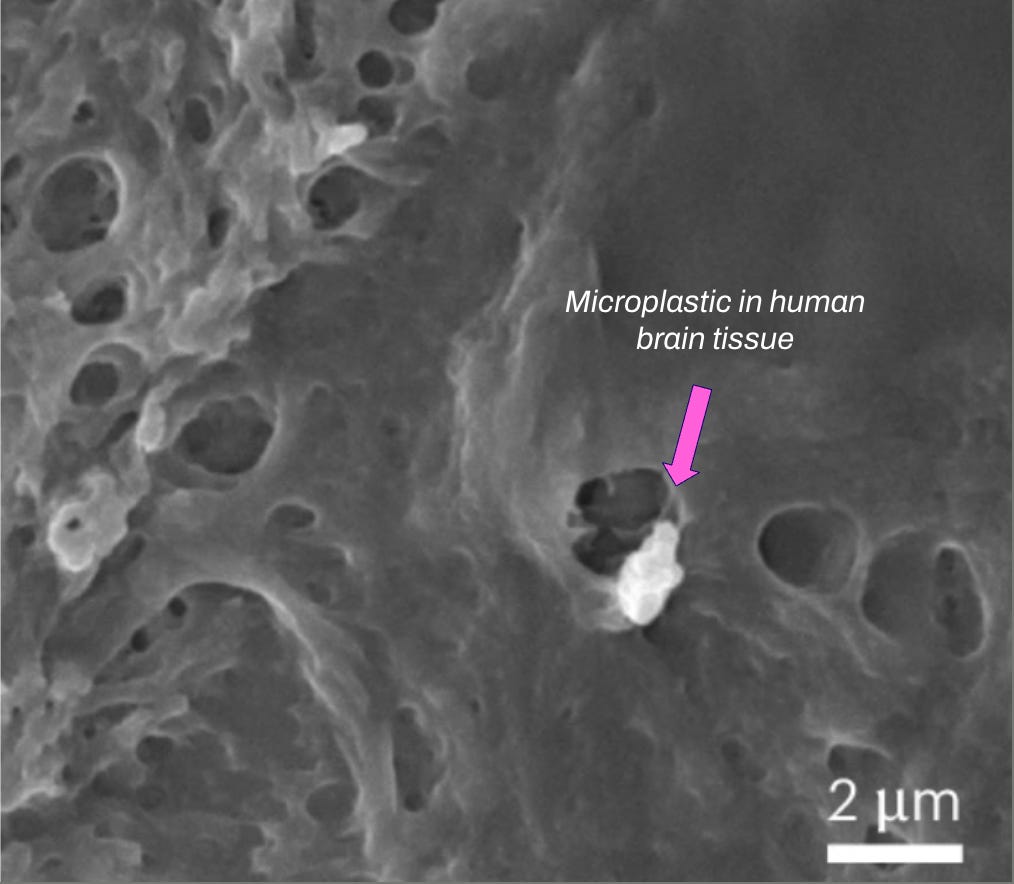
Microplastics have been detected in human tissue with increasing frequency. A 2022 study found microplastics in nearly 80% of blood samples tested. Subsequent research has identified microplastic particles in lung tissue, placental tissue, and most recently, brain tissue. Most notably, scientists found that micro- and nanoplastic concentrations in the brain increased by ~50% from 2016 to 2024.
A 2024 study published in the New England Journal of Medicine found that patients with micro- and nanoplastics detected in arterial plaque had elevated cardiovascular risk, though the researchers were careful to note that the 4.5x higher risk is a correlation, not proven causation. Similarly, a 2020 study showed that microplastics can trigger inflammatory responses, oxidative stress, and potential endocrine disruption in cellular and animal models.
In one of the most provocative (and headline grabbing) studies, scientists estimated that humans may ingest up to 5 grams of plastic weekly, roughly the weight of a credit card, though this figure is debated and depends heavily on methodology and assumptions.
What we don’t know
Despite accumulating evidence, the long-term health effects of chronic low-level microplastic exposure remain uncertain. There is some evidence that ingested microplastics can transit the gut. But given that there is no known biological mechanism for removing them or breaking them down, it appears that bioaccumulation in lipid-rich tissues, and especially the brain, is likely.
Furthermore, given the range of contaminants in our food, our water, and our air, it is also unclear where microplastics sit in the hierarchy of harmful substances. Are they relatively more or less harmful than PFAS or phthalates? Should we focus more on eliminating one over the other?
Finally, it’s worth noting that the contribution of cosmetics to the total body burden of microplastics is also unclear. Microplastics enter our bodies from food packaging, water, textiles, dust, and countless other sources. What percentage comes specifically from rinse-off or leave-on beauty products or color cosmetics? Are some product formats better or worse than others?
In essence, the science is still emerging and the data isn’t yet precise enough for us to be certain.
Is “Microplastics-Free” the Next Wave in Clean Beauty?
The precautionary principle often drives the consumer mindset and changes in behavior: even if the science isn’t conclusive, many people see the headline and decide to buy alternative products that they perceive to be better for their long-term health and the wellbeing of loved ones. It’s a pattern we’ve seen before in beauty:
Parabens: A 2004 study detected trace amounts of parabens in 20 breast tumor tissue samples. Regulators (EU SCCS/1652/23, December 2023) and experts have extensively studied parabens and found them safe at recommended use levels (0.4%-0.8%). Yet “paraben-free” became a selling point and brands rapidly reformulated.
Sulfates: Likewise, sodium lauryl sulfate and related surfactants fell out of favor following viral internet claims that it was a carcinogen. Despite extensive reviews showing that to be false, “sulfate-free” became a new trend in shampoos and is now a $3bn+ category.
To date, the plastics debate in beauty has mostly focused on packaging. Forward-thinking brands have offered consumers recyclable materials, eliminated unnecessary extras, offered refillable options, and supported upcycling of materials.
But is the actual formula the next frontier? Could consumers rapidly switch to demanding formulas without synthetic polymers? Some brands - like Nivea for example - have already phased out synthetic polymers in favor of biodegradable alternatives. This is likely in preparation for the upcoming EU bans on “synthetic polymer microparticles”. But it’s also because consumer perceptions are rapidly shifting.
At the retail level, carbomers and acrylates are not yet on the no-no lists. But with EU regulations in place and consumer awareness rising, it may be just a matter of time before they are added.
Perception Is Reality
Whether the science is settled or not, consumer perception is shifting. “Microplastics” are now synonymous with pictures of plastic particles in our brains that technical explanations cannot easily neutralize. In the attention economy, brands have to navigate this difficult space between scientific fact and consumer perceptions. Forming a defensive crouch and saying the science is uncertain seems less likely to win out versus an approach that embraces shifting consumer sentiment, (re)formulates proactively, and positions products and messaging ahead of the trend.
The brands that get ahead of this curve won’t just be compliant, they’ll likely own the narrative. Next week in the final post in this series, we will examine the natural polymer landscape: what’s actually available, what works, what doesn’t, and what the future of cosmetic formulation looks like when the performance-versus-natural trade-off starts to dissolve.