

There’s a moment every formulator knows.
You’re standing at the bench, watching a carbomer gel come together. The viscosity builds exactly as expected. The clarity is perfect. The texture — elegant, non-tacky, a water-break feel that consumers love but can’t articulate — emerges like it was always meant to be there.

For decades, carbomers have turned formulators into artists. They gave them control, precision and the ability to create textures and experiences that natural polymers simply couldn’t match.
To be clear: this isn’t a hit piece on carbomers. It’s an honest reckoning with what they gave us as an industry and what we’ve had to accept in return.
What Carbomers Actually Do
If you’ve spent any time in cosmetic formulation, you already know the answer. But it’s worth articulating because the list is remarkable:
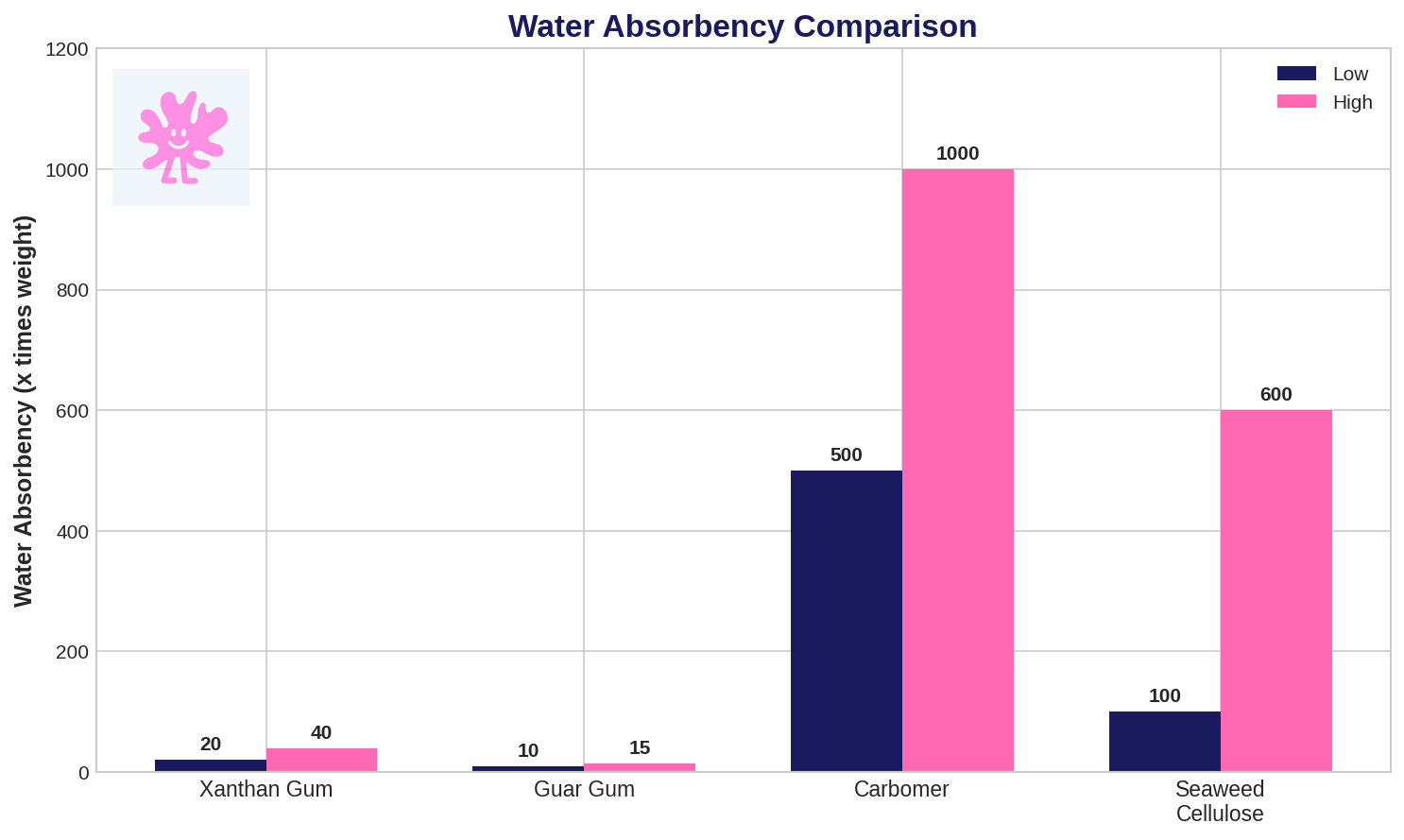
Water absorbency: Carbomers absorb 500-1,000 times their weight in water. Compare that to xanthan gum at 20-40x or guar gum at 10-15x. This isn’t an incremental difference; it’s an order of magnitude.
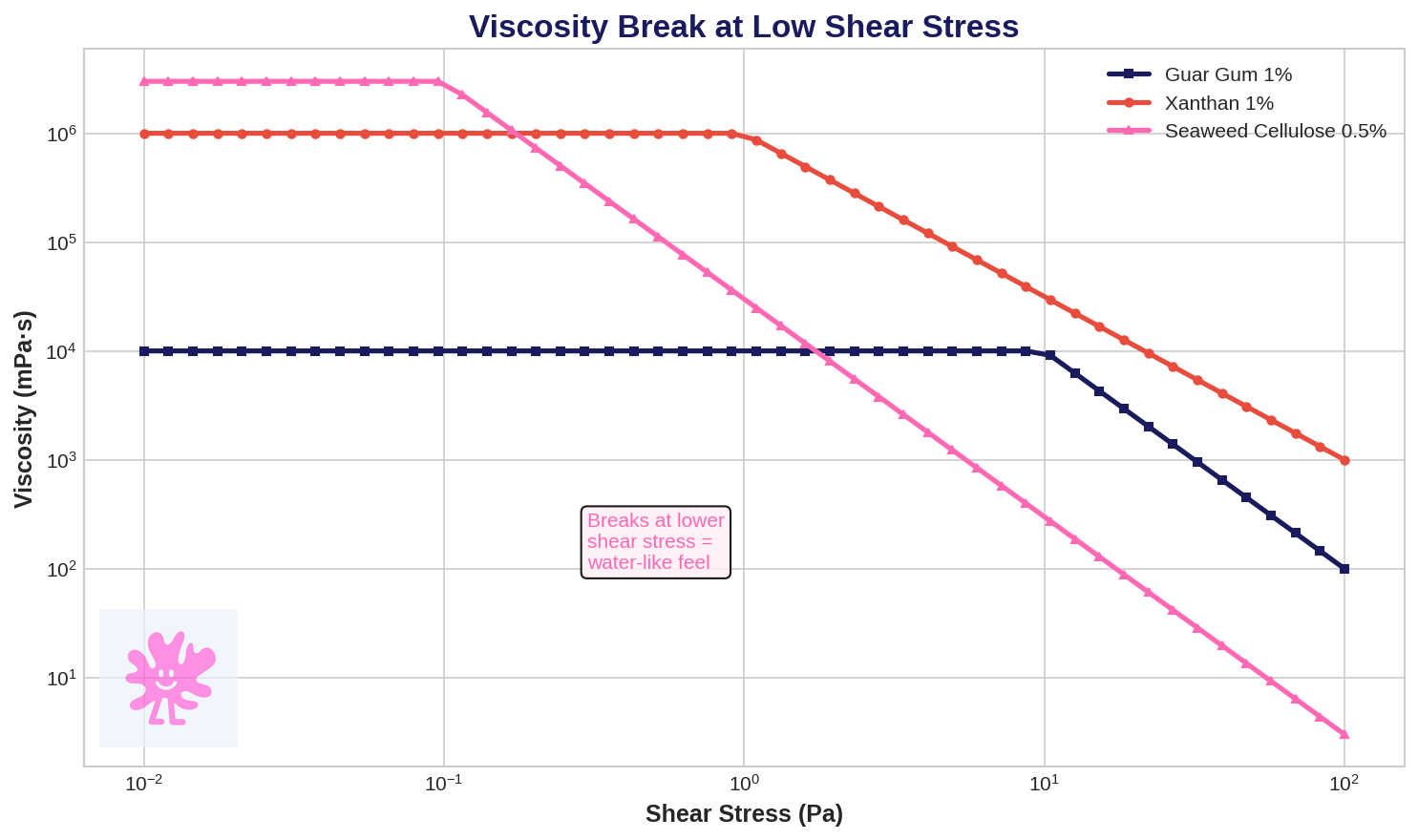
Shear thinning: Carbomers thin beautifully under shear, even at very low shear rates, with no low-shear plateau. This makes them ideal for spray applications; the product flows through the nozzle, then immediately recovers viscosity on the skin.
pH stability: Functional across pH 4-9, covering virtually every cosmetic application.
Electrolyte tolerance: Unlike many natural polymers, carbomers can handle the salt loads common in cosmetic formulations.
Texture: Clean, non-tacky, with that characteristic quick-break feel. The viscosity drops immediately when you rub it on skin, leaving no residue.
Low use levels: 0.1-0.6% is typically all you need, keeping formulation costs manageable.
This combination of properties isn’t just useful. It’s why carbomers became the default choice for an entire generation of formulators. When you needed a rheology modifier that would simply work, you reached for a carbomer.
The Xanthan Gum Compromise
And then the conversation changed. As “clean beauty” emerged and brands began pursuing natural formulations, R&D teams faced a familiar question: what’s the natural alternative? The answer, more often than not, was xanthan gum.
Xanthan gum is natural, widely available and cost-effective. It’s been used in food and cosmetics for decades, and, on paper, it seems like a reasonable substitute. But in practice, formulators discovered what the data always showed: xanthan gum is not carbomer.
The texture problem: Xanthan gum gets slimy at higher concentrations. The gluey, stringy quality that works fine in a salad dressing becomes a liability in a face cream. The sensory experience is fundamentally different and consumers notice it, even if they can’t explain why the product feels “off.”
The suspension problem: Xanthan gum can’t suspend heavy particles at low viscosity. If you’re making a mineral sunscreen with zinc oxide or titanium dioxide, you need significant viscosity to keep those particles distributed. Which means using a lot of xanthan gum and creating a thick, heavy product rather than a light, sprayable one.
The shear thinning problem: Xanthan requires much higher shear stress to break viscosity. On the rheology curve, you can see it holding onto that tackiness far longer than carbomers. The result: a product that doesn’t feel like it “releases” when you rub it into the skin, leaving consumers with that “sticky” or “tacky” experience.
The formulation problem: Xanthan is finicky to work with. pH sensitivity, pre-dispersing with a glycol to avoid fish eyes, careful hydration requirements, temperature considerations—the production process becomes more complex, more prone to failure, more expensive to perfect in development.
None of this is news to anyone who’s spent time at the bench. This “natural tax” has meant accepting inferior sensory performance as the cost of having a clean label. It’s one of the unspoken realities of our industry.
What Suffers: The Artistry
Formulation isn’t just chemistry. At its best, it’s artistry. The best formulators create textures and sensory experiences that delights consumers when they open a jar or when they spray their SPF on their arm.

Carbomers enabled that artistry by being controllable. You could dial in the texture, the exact rheology profile, the spray pattern. You didn’t have to worry about trade offs. You could dream and do what you do best - create!
Low-viscosity suspensions that still hold heavy minerals that you can spray rather than just squeeze from a tube? Sure!
Water-break textures that feel light and fresh in a cream but transform to water on contact with skin? Done!
Whipped textures that hold their shape in the jar but melt on application? No problems!
Stable emulsions across temperature variations, humidity changes, and the indignities of shipping and storage. Easy!
When formulators switched to xanthan gum and other natural alternatives, they didn’t just lose performance. They lost creative freedom. The formulation had to work within the constraints of the polymer, rather than the polymer enabling whatever the formulator imagined.
The Quiet Trade-Off
Of course, there’s a reason this conversation is happening now rather than twenty years ago.
Carbomers are synthetic polymers, derived from petrochemicals. For a long time, this wasn’t something the industry talked about much. They worked, they were safe, they were cost-effective. What else mattered?
But more recently, consumers care more about what’s in their products. Today, it’s not only the actives they’re buying for, but the functional ingredients too that make up the bulk of a formulation. If microbeads were the first phase, then synthetic polymers are likely next. The phrase “liquid plastics” has begun appearing in beauty media, describing synthetic polymers that persist in the environment after they wash down the drain.

Regulatory frameworks are beginning to classify these materials differently and phase them out. (Sneak peek: in our next post we’ll be diving deep into the EU regulation 2023/2025). What was once a minor line item on an INCI list is rapidly becoming a compliance question, threatening top line revenues for billions of dollars of existing products on the shelf.
Retail buyers are asking questions they didn’t ask five years ago. “Clean beauty” standards at major retailers now extend beyond the legacy targets like parabens or sulfates to include considerations about synthetic polymers.
We don’t need to litigate whether these concerns are fully justified or precisely articulated. The market has made its position clear: the landscape for synthetic polymers is changing.
The Question Worth Asking
For years, the question facing formulators has been: performance or natural? Artistry or clean label? It’s been a genuine dilemma, because the natural alternatives genuinely haven’t matched what carbomers could do. The choice was real, and the trade-offs were painful.
But luckily, technology is moving fast. Innovations in natural materials means that the trade-off between performance and 100% plant derived is actually an artifact of where the science was, rather than where it is today.
So a more pertinent question is this: what becomes possible when the constraints that defined formulation for the past thirty years start to dissolve?
In the next three posts in this series will dig into the regulatory landscape reshaping polymer choices, the consumer perception shift around “liquid plastics,” and what the natural polymer space actually looks like today.