

In 2010, a recovering VC named Michael Preysman started a clothing company on a strange premise: he would tell you exactly what your clothes cost to make. Open the page for their Organic Cotton Tee, and there it was: $3.36 for materials, $0.78 for hardware, $1.70 for labor, 96 cents for duties, and 53 cents for transport. A true cost of $7.33 for a shirt they sold for $30. The rest of the industry marked up seven or eight times and called the math a trade secret.
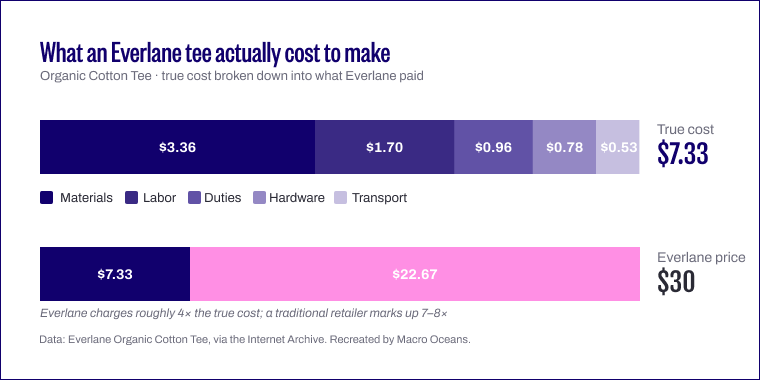
Everlane called it radical transparency, trademarked the phrase, and built buzz and a cult following around it. The strategy worked because it answered a question people didn’t know they were allowed to ask: where does my money actually go?
Sharp observers will know that Everlane doesn’t really do this anymore. So if it was such a winning idea, why did they stop? The simple answer is because once the transparency novelty wears off, consumers start asking why you’re not investing more in quality and supply chains. Around 2020, Everlane quietly backed away from the cost breakdowns and moved their transparency story to supply chains and sustainability.
What can the beauty industry learn from this story? Consumers intuitively understand that it does not cost $65 to make their favorite face cream. But when a brand uses adjectives such as “clean” and “sustainable” or “planet-friendly” they expect it to mean something substantial. As an industry, we have used sustainability to make us feel good, but we’ve done less of the hard work to substantiate those claims with hard facts or numbers that quantify impact. Does ingredient A have a bigger carbon footprint than B? Which packaging solution is more sustainable at the end of its life?
Very soon, the beauty industry will be forced to move away from bold adjectives towards hard facts. On September 27, 2026, the EU’s “greenwashing directive” on environmental claims will become enforceable, and vague green terms such as “eco-friendly,” “biodegradable,” “biobased” will become illegal unless they are substantiated with data. Brands that are found to be greenwashing will face stiff fines (up to 4% of annual turnover). So the era of sustainability storytelling is ending and a tougher, but hopefully better, era of substantiation is beginning.
Impactful measurements
At Macro Oceans, we started this journey by building a zero-waste process and a traceable supply chain to provide visibility from farm-to-formula. Now we are doubling down on transparency by providing all the data from our first full Life Cycle Assessment (LCA) for Big Kelp Hydration.
First up, some transparency about this LCA study. It was generously funded by GreenWave as part of the Kelp CoLab program and conducted by Planet FWD, an independent climate consulting firm. It follows ISO 14040 and 14044 standards and takes a cradle-to-gate approach. The LCA results have not been through a formal third-party independent review. However, we decided to publish the results now because, in our view, work in progress is more honest than waiting for a certificate for the extra polish.
We compared Big Kelp Hydration to hyaluronic acid (the Cadillac of hydration) and aloe vera (the industry workhorse). Every number is normalized to the amount of each ingredient used in one ounce (1oz) of finished product at recommended use rates so that we have a true apples-to-apples comparison.
Compared with hyaluronic acid, the production of Big Kelp Hydration uses 27 times less water and creates 85% fewer emissions. Across every category the assessment measured — energy, land, water quality, eutrophication — it comes out ahead by a wide margin and several by more than an order of magnitude.
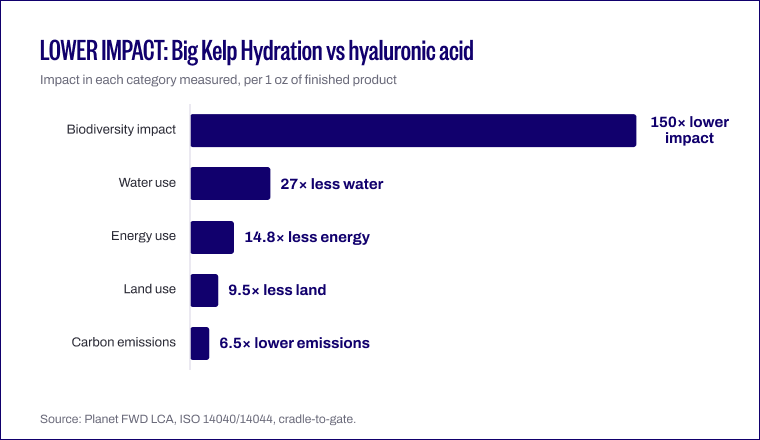
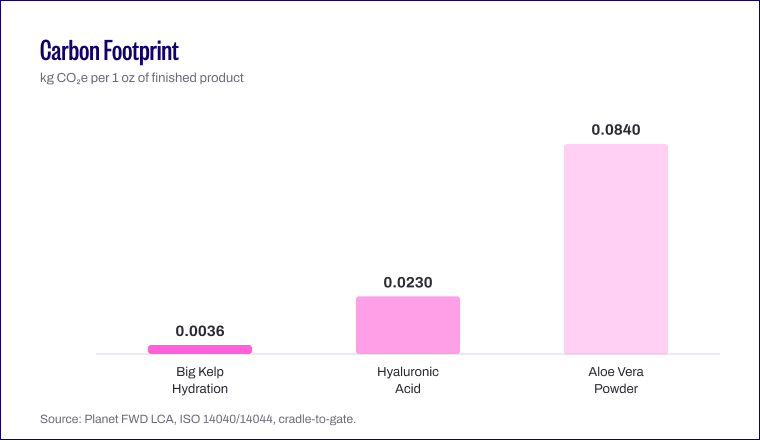
We thought Big Kelp Hydration would have a smaller footprint than other ingredients, but we were surprised by how much smaller it is. If you dig into why that is, there are two driving forces: (i) the zero-input feedstock, and (ii) our zero-waste process. Kelp uses no arable land, no freshwater irrigation, no fertilizer, no pesticide and it draws down carbon as it grows. Couple that with a low-energy, low-water process where co-products are upcycled, and you end up with a small footprint. Hyaluronic acid, by contrast, is built on energy-intensive and water-intensive fermentation. Aloe vera powder relies on energy-hungry spray-drying to remove water.
The part most companies would edit out
So far, so good. But if we’re being radically transparent, we have to admit that most of the impact in any consumer product lies beyond Big Kelp Hydration. Our measurement is cradle-to-gate; it only accounts for the impact from the farm to the factory door. We do not account for the finished-product manufacturing, consumer use, or end of life, where the energy and water for making the consumer product and then actually consuming the product can dominate the product’s total footprint.
Furthermore, these measurements are isolated to a single ingredient. A finished formula has a dozen or more ingredients. As of today, the industry has some estimates and averages like the one we used for hyaluronic acid and aloe vera. But in general, ingredient manufacturers do not publish rigorous impact data so that a brand can calculate the impact of a product on the shelf.
Finally, it’s worth pointing out that we recommend using Big Kelp Hydration in the formula at 3%, roughly six times the concentration of hyaluronic acid. Even accounting for the additional product in the bottle, our impact still comes out much lower per ounce of finished product.
Understanding Beauty’s real impact
The EU’s new rules pose a dilemma to many brands: how do we make honest claims about our product if we don’t have detailed data about the raw materials inside it? A formula’s footprint is largely decided upstream of the brand, which means that product substantiation now requires every ingredient manufacturer to provide an unprecedented level of detail on the ingredient’s footprint.
We’ve started on this journey with Big Kelp Hydration, but Big Kelp Flex — our seaweed polymer — is next in line. We haven’t run an assessment on it yet, but it’s the one I’m most excited about as we’ll be going head-to-head with petroleum-based polymers. Rest assured that once we have the data, we’ll publish it here so you have the detailed results - the good, the bad, the uncertain.
But, if I’m honest, the number I actually want to see is the one that no one has yet to produce: the full impact for a finished formula. Imagine if a brand could account for the raw material, the packaging, the manufacturing so that the footprint reflected the best estimate of the real planetary impact, laid out the way that Everlane did it for the tee. Nobody (as far as I know!) has done this in beauty. Ingredients sometimes have LCA data, but product use and end-of-life data are often missing. It hasn’t been done because it’s hard. But hard is not impossible. And to me, “nobody’s done it” sounds like a good reason to do it! So, if you want to be the first brand in the world to calculate a cradle-to-grave footprint for your product, you know who to call.
Could we see a list of products using your kelp ingredient? I’d love to try one out